Building a Distributed Key-Value Store in C++ (Part 1)
- A key-value store is a glorified dictionary - start with the simplest possible in-memory implementation before adding any distribution concerns.
- Defining only three operations (put, get, del) up front keeps the first phase small enough to ship and test.
- Shipping phase by phase forces you to confront distributed problems one at a time instead of all at once.
I wanted to understand distributed systems properly, not just read about them. So I decided to build a key-value store from scratch in C++ - something that starts as a simple std::unordered_map and eventually becomes a multi-node cluster with leader election. This is the first post in that series.
The plan is six phases, built one at a time. Here's the rough roadmap:
- Phase 1 - Local store ✅: in-memory
KVStorewithput,get,del - Phase 2 - Persistence: append-only log for crash recovery
- Phase 3 - Networking: TCP server and CLI client
- Phase 4 - Multi-node: replication across instances
- Phase 5 - Consensus: leader election (Bully algorithm)
- Phase 6 - Testing & resilience: fuzzing, chaos, graceful failure
Phase 1: the simplest thing that works
A key-value store is just a dictionary with some extras. For now, the extras are zero.
File structure
distribkvstore/
├── CMakeLists.txt
├── src/
│   ├── kvstore.cpp
│   ├── kvstore.hpp
│   └── main.cpp
└── tests/
    └── test_kvstore.cpp  (planned)
Three operations
put(key, value)- insert or updateget(key)- retrievedel(key)- delete
Example usage
int main() {
  KVStore store;
  store.put("hello", "world");

  if (auto val = store.get("hello")) {
    std::cout << "GET hello: " << *val << "\n";
  }

  if (store.del("hello")) {
    std::cout << "deleted hello\n";
  }

  if (!store.get("hello")) {
    std::cout << "hello not found after deletion\n";
  }

  return 0;
}
That's it for Phase 1. It compiles, it runs, and it's the foundation for everything else.
Architecture
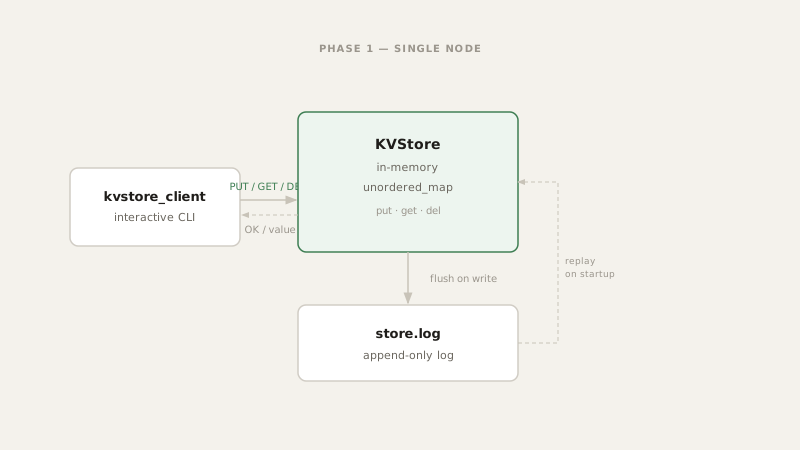
What's next
Part 2 adds unit tests and an append-only log for persistence. Without that, the store forgets everything when the process exits.
...s is the final post in the series. If you are arriving here for the first time, [Part 1](/notes/building-distributed-kv-store-pt1) is the right starting point - it covers the in-memory store and the overall roa...
...tests before introducing a test harness for socket I/O. </KeyTakeaways> Parts [1](/notes/building-distributed-kv-store-pt1) and [2](/notes/building-distributed-kv-store-pt2) gave us a persistent, tested...

Data is my veggies - healthy, versatile, and sometimes hard to digest, but in the end, it always brings value.