Balanced Isn't Average: Conflict Styles and NVC as a New People Lead
- A balanced conflict style profile isn't a lack of strength, it's the ability to flex depending on what the situation actually calls for.
- Most conflict escalates not because of the underlying issue, but because of the form the language takes: You-statements trigger defensiveness before the real problem can even be addressed.
- NVC doesn't replace your conflict style. It's yet another tool for your toolbox to defuse these kind of situations.
Stepping into leadership came with a shift I didn't fully expect: the job is less about managing and more about developing, helping people on my team grow, unblocking them, and creating the conditions for them to do their best work. None of that is a skill you already have on day one. It's something you build.
So I've been treating it that way. Over the past few months I've deliberately put time and budget into the human side of the role: negotiation, conflict management, difficult conversations, the topics that don't show up on a technical roadmap but decide whether a team actually functions. Most recently that meant a workshop through the Austrian Association for Negotiation & Conflict Management, focused on conflict styles and communication under pressure.
I went in expecting a generic framework refresher. I came out with a surprisingly personal result.
The Thomas-Kilmann Conflict Mode Instrument
The workshop opened with a useful framing: every conflict operates on two levels simultaneously, a factual level (what actually happened, the numbers and events and observable facts) and a relational level (how it felt, what it said about trust, respect, and worth). Most conversations fail because one person is addressing the facts while the other is stuck in the relational layer, and neither of them realises it.
The Thomas-Kilmann model, one of the most widely used frameworks for understanding how people respond to conflict. It maps five conflict styles across two dimensions: how assertive you are (pushing for your own needs) and how cooperative you are (considering the other person's needs).
The five styles are:
- Competing: assertive, low cooperation. You pursue your position firmly. Power-oriented: I win, you lose.
- Collaborating: assertive and cooperative. You look for a solution that works for everyone. I win, you win.
- Compromising: middle ground. Both sides give a little to reach an agreement. We each give a little, we each get a little.
- Accommodating: low assertiveness, high cooperation. You prioritise the other person's needs over your own. I lose, you win.
- Avoiding: neither assertive nor cooperative. You sidestep or delay the conflict entirely. I'll deal with it later, or never.
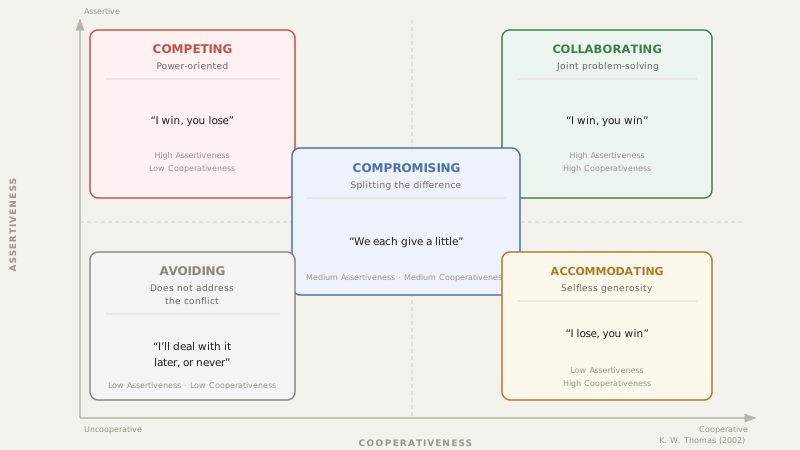
No style is inherently good or bad. Each has situations where it works well and specific strategic risks when overused. The formula the workshop kept returning to: Effectiveness = Situation + Skill.
My result and what I made of it
Then came the test. I went in half-expecting to see one dominant style and some clear peak that would tell me "this is how you handle conflict." Instead I got something flat: Average across Competing, Collaborating, Compromising, and Accommodating. Low only on Avoiding.
My first reaction was mild disappointment. Average across the board doesn't sound like a strength. I'd hoped for something more defined.
A balanced profile isn't the absence of a strength. It's flexibility and flexibility is exactly what a people lead needs.
But sitting with it for a bit, I started to see it differently. Being balanced across four styles doesn't mean you're mediocre at all of them. It means you're not locked into one. You can compete when the situation calls for it, collaborate when there's time and trust, compromise when you need to move forward, and accommodate when the relationship matters more than the outcome.
The low Avoiding score actually felt like the most meaningful data point. In leadership, conflict doesn't disappear because you ignore it, it just lingers. Not defaulting to avoidance means I'm more likely to actually address things when they need to be addressed.
Knowing your own profile is one thing. Knowing your counterpart's default style is another, a colleague's Competing mode isn't necessarily an attack; it's often just how they're wired under pressure. That second layer of awareness is where the model gets genuinely useful in team dynamics.
The language of escalation
Knowing your conflict style is one layer of awareness. The next layer and this was the part of the workshop I found most immediately applicable, is recognising whether your language is escalating or de-escalating the situation.
Most conflict doesn't get worse because of the underlying issue. It gets worse because of the form the language takes. Certain patterns reliably push conflict upward regardless of which style you're coming from:
- You-statements / accusations: "You have..." / "You should have better..."
- Evaluating / lecturing: "Typical for you that..."
- Insinuation: implying something negative without saying it directly
- Irony or sarcasm: "Interesting idea, considering it comes from you..."
- Interrogating: asking questions as veiled accusations rather than genuine curiosity
When someone receives a You-statement, their first instinct is almost never "you're right, I'll change." It's to defend, counter-attack, or shut down, regardless of which conflict style either party is using.
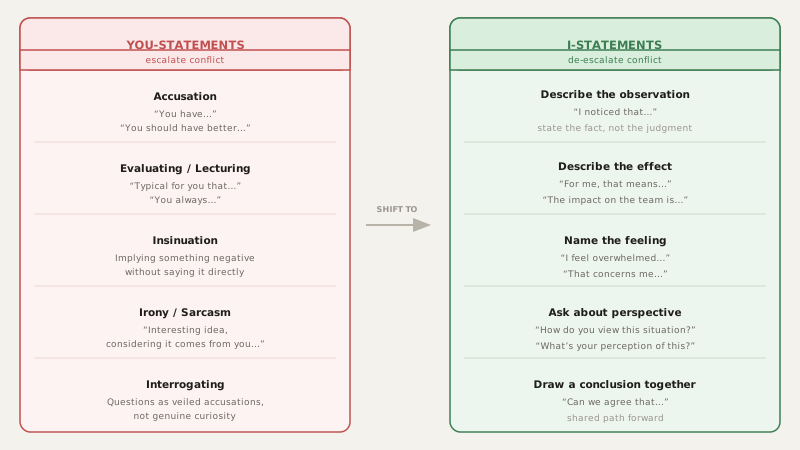
The I-statement sequence moves from your experience ➡️ the impact ➡️ your feeling ➡️ their perspective ➡️ a shared conclusion. That arc is not accidental, it's the structure of de-escalation. NVC builds the full framework on top of it.
Non-Violent Communication: a different way to respond
NVC, developed by Marshall Rosenberg, gives the de-escalation arc a complete structure: Observation ➡️ Feeling ➡️ Need ➡️ Request.
The four steps of NVC
- Observation: describe what happened, without evaluation or blame. Facts only.
- Feeling: name how it made you feel. Not "you made me feel", just what's true for you.
- Need: identify the underlying need behind the feeling. What were you counting on?
- Request: make a concrete, actionable ask. Not a demand, something the other person can actually respond to.
What the workshop made clear is that NVC doesn't replace your conflict style. It operates at a different level entirely, it's the language layer sitting underneath whatever mode you're in. And crucially, each TKI style has a specific blind spot in conflict, and NVC's four steps address different ones.
A Competitor is clear on what they want but has often stopped listening to what the other person actually needs. The Needs step forces that question back into the room. A Collaborator may jump to joint solutions before both parties have named their real needs, the same step keeps them honest. A Compromiser reaches middle ground too quickly, NVC slows them down to ask whether a better solution exists before anyone has to give anything up.
A compromise reached before both parties have named their real needs often doesn't hold. The unmet needs resurface later, as the same conflict, or as quiet resentment. Before agreeing to middle ground, ask: have we both actually said what we need? If not, you may be settling for less than necessary.
An Avoider often doesn't re-enter the conversation because they lack a low-aggression script. NVC gives them one. And an Accommodator needs NVC mostly as an internal exercise first: name your own need before you give it away.
For someone with a balanced profile like mine, the value is different: it's less about fixing a single blind spot and more about having a consistent tool that works regardless of which mode I'm in. The four steps are the same whether I'm competing or accommodating, what changes is which step I need to slow down on given the situation.
Putting it into practice
Here's the kind of message that can land in your inbox the morning of a customer's board meeting:
"WHAT THE HELL HAPPENED TO OUR NUMBERS?! I pulled up the revenue dashboard to prep our board deck this morning and it was DOWN 40% overnight! I nearly walked into that meeting with numbers that were flat out wrong!
We have told you SO MANY TIMES that this pipeline feeds directly into board reporting and it CANNOT be wrong. You promised me last quarter that the nightly load was stable.
I heard someone on your team pushed a schema change upstream last week, was that even tested before it went out? Do you people not review anything before it hits production?
We pay you a lot of money to keep this data correct. FIX IT TODAY."
Every sentence is a You-statement. There's accusation, interrogation, insinuation about the colleague who made the schema change, and a veiled threat at the end. The instinctive response is to either go defensive ("we followed the process") or immediately apologetic in a way that accepts all blame. Neither helps.
NVC asks you to first look past the tone and separate the two levels of what's happening. The factual level is manageable: an upstream schema change broke a join in the nightly transformation job, and revenue was undercounted for one day. The relational level is where the real charge is: they feel embarrassed for almost presenting wrong numbers to their own board, anxious about what else might be wrong, and worried about whether they can trust this pipeline going forward.
- Observation: An upstream schema change broke a join in last night's transformation job, which undercounted revenue on the dashboard. The customer caught the discrepancy themselves, right before using it in a board meeting.
- Feeling: Anxious, on edge, and notably embarrassed. They're worried about what else might be wrong and what it would have cost them to present the wrong numbers.
- Need: Reliability. Trust that a pipeline feeding board-level reporting is protected from upstream changes, and that they'll be told before things affect them, not after.
Once you see that, you can respond to the actual problem instead of reacting to the anger. An NVC-informed reply addresses the factual layer directly, acknowledges the relational one without spelling it out, and ends with something concrete:
"Thank you for flagging this, and I'm sorry it surfaced right before your board meeting. That's exactly the kind of moment this shouldn't happen in.
What happened: an upstream schema change last week broke a join in the nightly transformation job, which undercounted yesterday's revenue figures on the dashboard. That should have been caught by our schema checks before reaching production, and I'm looking into why it wasn't.
We've corrected the numbers and re-run the pipeline, so the dashboard now reflects the right figures. I'll send you a short write-up of the root cause and the safeguard we're adding before end of day. Would a quick call tomorrow work so I can walk you through it directly?"
Same situation. Completely different dynamic. The facts are stated without deflecting blame onto the colleague. The relational layer, trust, reliability, being told before things affect them, is acknowledged without being named. And there's a concrete next step rather than a vague promise.
What I'm taking into the day-to-day
Peace of mind is not the absence of conflict, but the ability to cope with it.
I didn't walk out of that workshop with a new personality or a conflict superpower. What I walked out with was a bit more self-awareness and two concrete tools.
Knowing my TKI profile means I can be intentional about which mode I'm in. When I notice I'm Competing, I can ask myself if this situation actually calls for it. When I feel the pull to Accommodate just to keep things smooth, I can ask whether I'm genuinely prioritising the relationship or just avoiding discomfort, which, according to my results, isn't really my style anyway.
The blind spot concept has been the more interesting addition. Even with a balanced profile, I've started asking: which mode am I in right now, and what does that mode tend to miss? If I'm about to have a difficult conversation in collaborative mode, I need to make sure I'm actually surfacing needs, mine and theirs, before we start solving anything. If I'm compromising, I should pause long enough to ask whether we've both named what we need, or whether we're just splitting the difference to close the conversation.
And NVC has changed how I read tense messages. Before, something like the email above would put me immediately in response mode, thinking about what to defend, what to fix, what to say. Now I try to slow down long enough to ask: what's the factual complaint here, what's the relational charge underneath it, and what does this person actually need? The reply almost writes itself once you answer those two questions.
As a people lead, conflict isn't something that happens to you. It's something you navigate on behalf of your team. Getting better at it feels like one of the more valuable investments I can make right now.

Data is my veggies - healthy, versatile, and sometimes hard to digest, but in the end, it always brings value.